

VIMS EHSVIMS EHS

Contractor site access in a manufacturing plant — safety procedure, documents and site induction

Contractor site access is a documented process in which the host site checks a contractor and its workers, informs them about site hazards and only then allows them to enter and start work. It covers company pre-qualification, competence checks, site induction, entry control and supervision during work.

This guide answers the questions safety, maintenance, procurement and security managers search for: which documents to request from a contractor, who trains contractor workers, whether you may collect copies of medical certificates, how to shorten the morning gate queue and who is liable for an accident. Unlike our construction guide, it focuses on a plant that keeps running during service work.

  • Contractors
  • External companies
  • Article 208
  • Site induction
  • Entry control
  • GDPR

Published: 2026-11-20 · Updated: 2026-11-20 · 11 min read · Varilo deployment team

Manufacturing plant gate in the morning: service contractors in helmets and vests, a safety officer with a tablet showing a green access confirmation — VIMS EHS illustration

1. How does contractor access in a plant differ from a construction site?

Short answer: on a construction site everyone works on one project, organised by building law, the site manager and the health and safety plan. In an operating plant a contractor walks between running machines, forklift traffic, pressurised systems and chemicals they know nothing about. The host creates most of the hazards, so the host must communicate them.

Plants receive machine service engineers, installation crews, cleaning firms, electricians, lifting-equipment technicians, IT providers and measurement labs — often several companies a day for a few hours. The procedure therefore has to be fast for short visits and complete for high-risk work. Construction rules are covered in the guide on subcontractor safety supervision on construction sites.
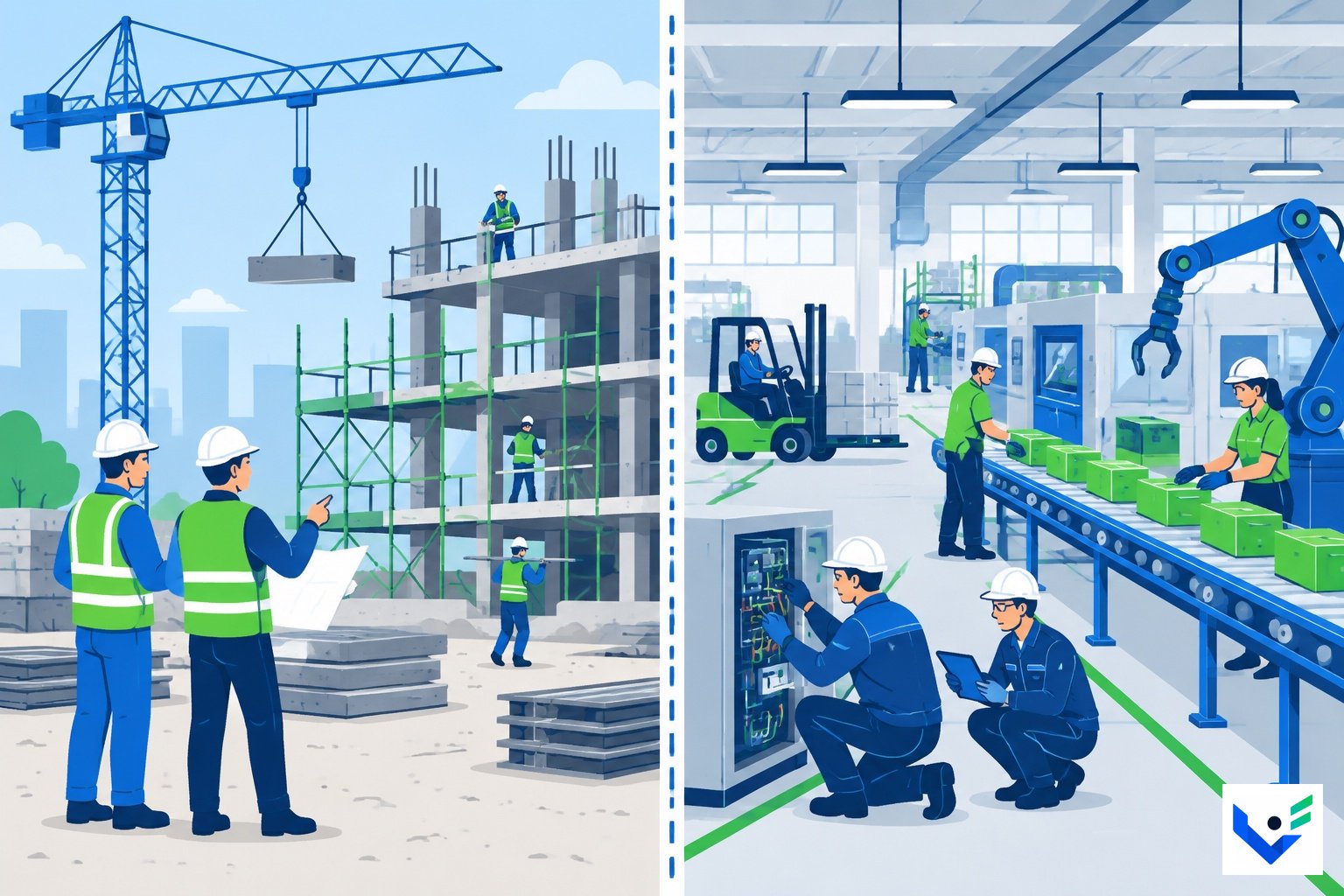
Comparison: a construction site with crane and scaffolding on the left, an operating production hall with conveyor, forklift and robot on the right, where contractors work next to plant employees — VIMS EHS illustration
Illustrative: in an operating plant the contractor works next to production and the host creates the hazards.

2. Which rules place duties on the host plant?

Short answer: above all article 208 of the Polish Labour Code. When employees of different employers work at the same time in the same place, the employers must cooperate, appoint a coordinator supervising safety, agree how they work together including emergency procedures, and inform each other's workers about hazards. Appointing a coordinator does not release any employer from duties towards its own people.

Article 304 requires safe conditions also for people working under contracts other than employment and for self-employed persons on premises designated by the employer. The contractor's employer remains responsible for general training, medical examinations, personal protective equipment and supervision of its own staff (articles 207, 211 and 237³). Particularly hazardous work adds the requirements of the general OSH regulation — written instruction, supervision and a standby person.

The content of the article 208 agreement, the coordinator's duties and accident liability will be covered in a separate guide. Here we describe the practical access process that delivers those duties.

3. What does the access procedure look like step by step?

Short answer: five stages. 1) Company pre-qualification — before signing the contract, check the contractor's risk assessment for the scope, method statements, liability insurance and accident record. 2) Worker checks — a named list with confirmation of safety training, fitness for work and competence for specific tasks. 3) Site induction — site hazards and rules, ending with confirmation of understanding.

4) Entry control — the gatehouse or reception checks that the person is registered, inducted and holds valid documents, then issues a badge. 5) Supervision during work — permits to work for high-risk tasks, energy isolation, on-site inspections and job close-out. Every stage should leave a record, because after an accident the labour inspector and the insurer will ask what was checked and when.

In practice the biggest problem is not a missing procedure but its execution: documents arrive by email at the last minute, some are out of date and checks happen at 6 a.m. at the gate while vans queue at the barrier.

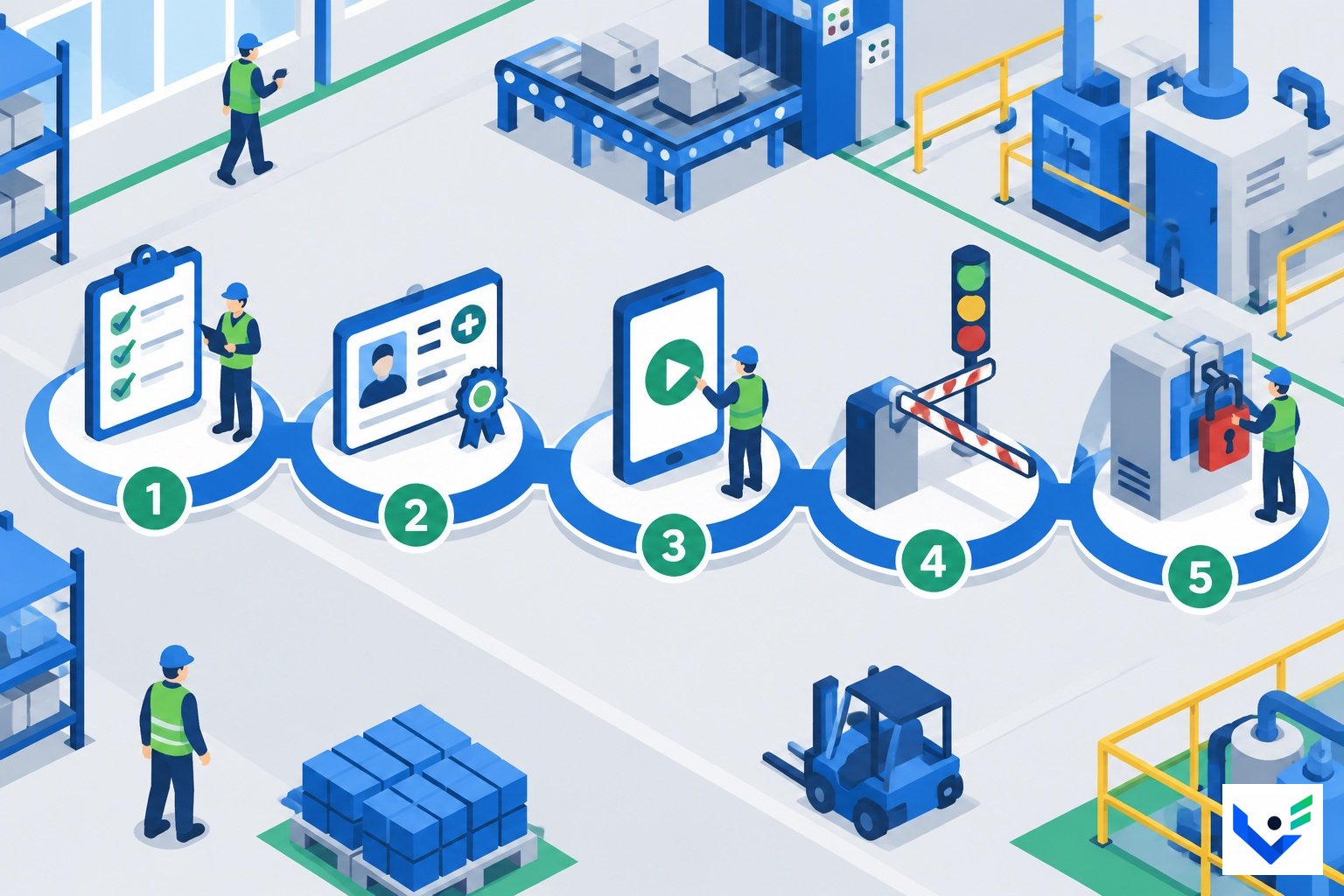
Five contractor access stages on a plant floor map: checklist, competence card, induction on a phone, barrier with green, yellow and red lights, lockout padlock on a machine — VIMS EHS illustration
Illustrative: pre-qualification, checks, site induction, entry control and supervision.

4. Which documents should you request from contractors and their workers?

Short answer: only those needed to assess the safety of the specific work. From the company: a risk assessment or method statement, liability insurance, a list of equipment and tools with inspections, and a named supervisor. From workers: confirmation of current safety training and fitness for the job.

Competences depend on the scope: Polish Office of Technical Inspection (UDT) certificates for forklift, mobile platform and crane operators, electrical qualification certificates for work on power equipment, work-at-height training, welding qualifications and, in explosive atmospheres, relevant competence. Put the requirements in the contract so the contractor knows them before pricing.

Check expiry dates, not just presence. The most common audit finding is a contractor file complete on contract signature and full of expired certificates a year later.

5. May you collect copies of contractor workers' medical certificates?

Short answer: carefully. A fitness-for-work certificate concerns health, and the GDPR treats health data as a special category (article 9). The host is not these people's employer, so collecting full copies 'just in case' breaches the data minimisation principle (article 5).

Safer practice: the contract obliges the contractor to send only people with valid examinations and training, and the host receives an employer's declaration or the expiry date, not the certificate content. Where documents are viewed, only authorised people see them, for the time needed to verify, with a defined purpose, legal basis and retention period. The gatehouse needs no access to documents — only whether the person is admitted.

6. Who trains contractor workers — the host or their employer?

Short answer: both, on different topics. The contractor's employer provides initial, job-specific and periodic training for the work performed. The host provides information about site hazards and rules — the site induction, which follows from the duty to inform under article 208.

A site induction usually covers escape routes and alarm signals, assembly points, prohibited zones and zones requiring PPE, forklift traffic, hazardous substances, permit-to-work and lockout rules, incident reporting and contacts. For foreign crews, deliver it in a language they understand — a signature under text nobody understood is no proof of information. Remote training rules are covered in the guide on online OSH training.

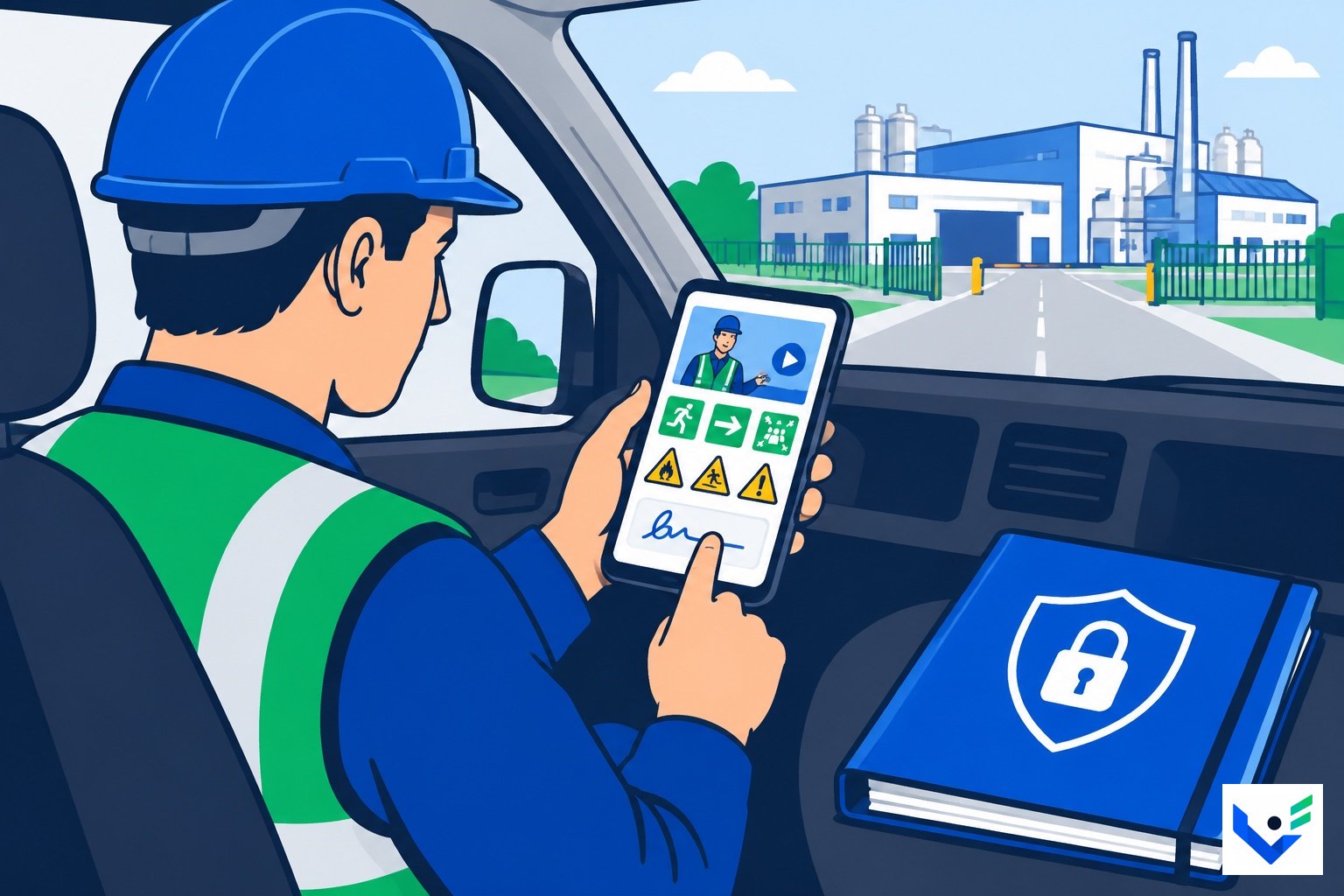
Contractor worker in a van before arriving at the plant, watching a site induction with evacuation pictograms on a smartphone and signing with a finger, next to a document folder with a data-protection symbol — VIMS EHS illustration
Illustrative: site induction before arrival and protection of contractor personal data.

7. How to shorten the gate queue without lowering standards

Short answer: move verification before the day of entry. If the worker list, documents and site induction are completed in advance, one question remains at the gate: is this person admitted for this work today? The answer should be unambiguous — admitted, admitted with a note (for example a document expiring soon) or not admitted.

Good practice also includes badges valid only for the contract period, an entry and exit log needed for evacuation roll calls, and a clear path when someone fails the check: who decides, who is notified and how the refusal is recorded. People banned from the site for serious violations should not be able to enter through another gate or with another company.

8. How to supervise contractors once on site

Short answer: through permits, inspections and the right to stop work. Hot work, work at height, confined spaces and work on energy systems require a permit to work (PTW) and lockout/tagout with the contractor's own padlocks.

The coordinator or contractor host carries out on-site inspections and records deficiencies as nonconformities with deadlines. Inspection results, accidents and nonconformities should feed contractor evaluation and decisions on future orders. The article 208 agreement should clearly give the coordinator the right to stop work immediately in case of imminent danger.

9. How VIMS supports contractor site access

The contractor management module replaces binders and email chains: the contractor's coordinator registers workers and required documents before arrival, and the safety team approves them in one place with reminders about expiring dates.

Contractor workers complete the site induction on their phone before entry, with confirmation of understanding and a signature. The gatehouse sees only the access status — green, yellow or red — with no view of sensitive data, and site bans apply across the plant. Nonconformities and contractor evaluation connect with the permit to work and training records modules.

Contractor access stages — who, what and when

Typical split of tasks in a site procedure; details are set by the article 208 agreement and the contract.

StageResponsibleWhat is checkedWhenTypical mistake
Company pre-qualificationProcurement + host safety teamRisk assessment, insurance, accidents, equipmentBefore contractChoosing on price only
Worker checksContractor coordinator + safety teamTraining, fitness for work, UDT and other competencesBefore arrivalCollecting medical certificates without need
Site inductionHostSite hazards and rules, understandingBefore first entry and after changesSignature without understanding the language
Entry controlGatehouse / receptionRegistration, induction, document validity, bansEvery entryChecking a paper file at the gate
SupervisionCoordinator, host contact, contractor supervisorPTW, LOTO, PPE, housekeepingDuring work and at close-outNo right to stop work

Contractor site access checklist

  • Safety requirements and documents are written into the tender and the contract.
  • The company passed pre-qualification: risk assessment, insurance, accident record, equipment.
  • An article 208 agreement is in place with a coordinator entitled to stop work.
  • The worker list is named and competences match the scope of work.
  • Health data is limited to confirmation of validity, in line with the GDPR.
  • Every worker completed a site induction in a language they understand.
  • The gatehouse checks access status and site bans at every entry.
  • High-risk work has a permit to work and energy isolation.
  • The entry and exit log allows a roll call during evacuation.
  • Nonconformities are recorded and affect contractor evaluation.

Frequently asked questions about contractor access in plants

Which safety documents should a contractor provide?

Usually a risk assessment or method statement, liability insurance, a named worker list with confirmation of safety training and fitness for work, and competences required for the scope, such as UDT or electrical certificates.

Who trains contractor workers in safety?

Their employer provides initial and periodic training. The host provides information about site hazards and rules in a site induction.

May a plant demand copies of contractor workers' medical certificates?

Better not. Under the GDPR minimisation principle an employer's declaration or the expiry date of the examination is enough.

Is an article 208 agreement mandatory?

The duty to cooperate and appoint a coordinator arises when employees of different employers work at the same time in the same place. A written agreement is the best proof it was fulfilled.

Can a site induction be delivered online?

Yes, if it conveys site hazards and rules clearly and ends with confirmation of understanding. It does not replace job-specific instruction, which is the contractor employer's duty.

Can the safety team stop a contractor's work?

Yes, if the agreement and site procedure provide for it, and in imminent danger to life or health work must stop immediately.

Contractor access without binders and queues

See how VIMS shortens the path from contractor registration to safe entry to your plant.