

VIMS EHSVIMS EHS

EHS knowledge base: process guides and a glossary of safety, quality and compliance terms

Practical guides to occupational risk assessment and workplace accidents, occupational hygiene and chemicals, technical safety, training and EHS culture, and lone worker protection.

Every article in the VIMS knowledge base comes from real deployments at Varilo customers and describes the process from the point of view of the person who runs it: the EHS specialist, the quality manager, the maintenance lead, or the board member accountable for compliance. Nothing here is written purely for search engines — each guide ends with the decisions you need to make and links to the modules where the process is actually carried out.

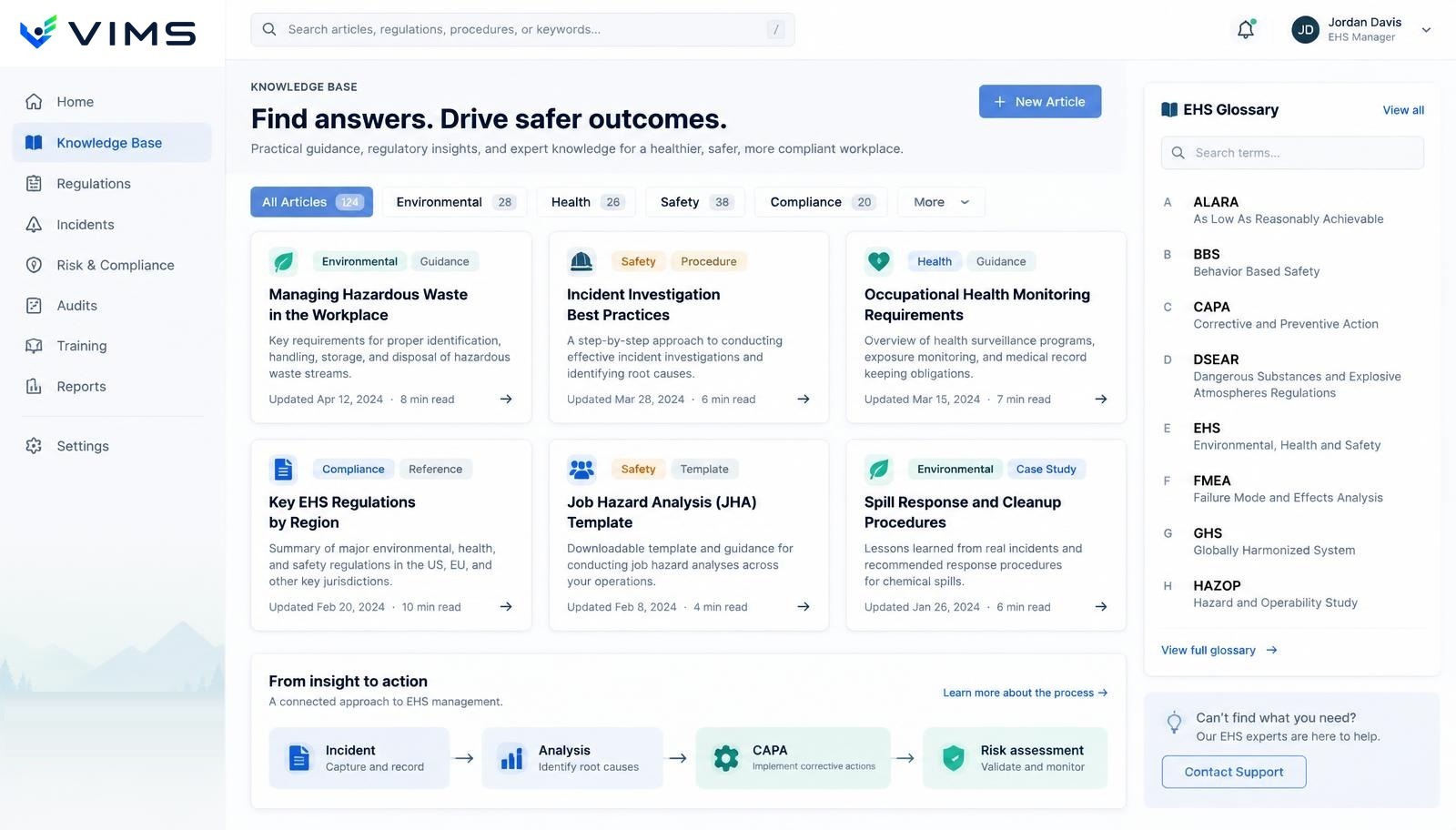
VIMS EHS knowledge base: list of process guides, search and glossary of safety terms
The VIMS knowledge base: process guides, term search and a shortcut through incident → analysis → CAPA → risk assessment.

Process guides

Guides are grouped into five areas. Pick an area to see only the related articles.

Risk assessment & incidentsUpdated: 2026-02-11·8 min

When an occupational risk assessment really needs updating

The question “how often should we update the risk assessment” is almost always the wrong one. The right question is: what had to change for the existing assessment to stop describing reality.

Related modules

Read the guide
Workplace hygiene & environmentUpdated: 2026-11-12·9 min

Safety data sheets and the chemical substances and SDS register: what really has to be under control

Safety data sheets are rarely the problem in themselves. The problem is that nobody knows how many substances are really on site, who ordered them, or whether the sheet in the binder matches the version of the product standing in the store.

Related modules

Read the guide
Training, culture & EHS systemsUpdated: 2026-11-01·11 min

Safety conversations and observations: BBS, safety walks, toolbox talks and more — types, differences, practice

Few people fill in a form. Almost everyone will talk at the machine — if they know nobody is looking for someone to blame and that the problem they raise will actually be fixed.

Related modules

Read the guide
Lone worker protectionUpdated: 2026-10-04·10 min

Lone worker safety: employer duties and protection systems — dedicated device or smartphone app?

In lone working the greatest danger is often not the incident itself but the time that passes before anyone knows about it. We explain what regulations expect, how to build an alarm procedure and how to choose between a dedicated device and a phone app.

Related modules

Read the guide
Technical safety & proceduresUpdated: 2026-10-04·14 min read

Lockout/Tagout (LOTO) in practice: energy isolation procedure, LOTO card and choosing lockout devices

A guide for maintenance, safety and production managers: how to prepare a LOTO card for a specific machine, how to isolate energy in 6 steps, which devices fit which energy sources and how to organise LOTO when several crews work together.

Related modules

Read the guide
Risk assessment & incidentsUpdated: 2026-10-04·12 min

Occupational risk assessment: choosing a method and calculating risk correctly

The method is not the goal. A good assessment can be repeated, separates risks well enough to set priorities and ends with concrete actions, not just a number in a table.

Related modules

Read the guide
Technical safety & proceduresUpdated: 2026-10-04·13 min read

Permit to Work (PTW) for high-risk work: regulations, roles, workflow and a digital permit template

A guide for EHS, maintenance, facility managers and contractor coordinators: when a permit is needed, who issues and signs it, a safe 5-step workflow and how a digital PTW differs from a paper pad.

Related modules

Read the guide
Risk assessment & incidentsUpdated: 2026-10-04·14 min read

Workplace accident investigation and root cause analysis (RCA): 5 Why, Ishikawa diagram and CAPA

A guide for safety professionals, investigation teams, managers and quality departments: how post-accident investigation works, why near misses are worth investigating, how to run 5 Why and Ishikawa step by step and how to close the analysis with CAPA actions.

Related modules

Read the guide
Training, culture & EHS systemsUpdated: 2026-11-01·12 min read

Which safety management software to choose? 11 questions before buying

Looking for safety software, a mobile safety app or a full EHS system? Before you compare vendors, work through the 11 questions worth asking before buying — whether you run a small company, a manufacturing plant or safety across several locations.

Related modules

Read the guide
Technical safety & proceduresUpdated: 2026-11-01·8 min read

Ladder inspections — how often, what to check and how to document them

This guide shows how to read a ladder's rating plate, what an inspection checklist should cover and how to build a record that stands up to an audit — without a binder full of slips.

Related modules

Read the guide
Technical safety & proceduresUpdated: 2026-11-01·9 min read

Pallet racking inspections — EN 15635, damage classification and documentation

This guide explains what a load notice must show, how the colour damage classification works, who may inspect racking and how to document checks so they stand up to inspectors and insurers.

Related modules

Read the guide
Technical safety & proceduresUpdated: 2026-11-12·14 min read

Fire extinguisher, hydrant and emergency equipment inspections — intervals, check scope and documentation of fire protection devices

This guide shows how often extinguishers, hydrants, emergency lighting, the fire power cut-off switch and emergency equipment are checked, what to read on an extinguisher nameplate, what an interim checklist should cover, who is responsible for deadlines and how to keep a register that survives dozens of safety points.

Related modules

Read the guide
Technical safety & proceduresUpdated: 2026-11-12·11 min read

Machinery Regulation (EU) 2023/1230 from 2027 — what the new “Machinery Directive” means for plants, maintenance and safety teams

People often search for the “new Machinery Directive 2027”, although the act is formally a regulation. This guide explains which changes apply to manufacturers and which to users — production plants, maintenance departments and safety teams — and how to prepare a machine fleet before January 2027.

Related modules

Read the guide
Technical safety & proceduresUpdated: 2026-11-12·12 min read

Subcontractor safety supervision on construction sites — document checks, Labour Code art. 208 and equipment admission

A construction site often hosts a dozen companies at once and crews change week to week. Written from the perspective of a site safety practitioner, this guide shows which documents to check before admitting a subcontractor, how to admit its power tools, site distribution boards, scaffolding and ladders, and why a spreadsheet stops working when staff rotation is high.

Related modules

Read the guide
Technical safety & proceduresUpdated: 2026-11-12·11 min read

Safety harness and fall protection equipment inspections — intervals, competent person, markings and approval for use

This guide answers the questions safety teams, PPE storekeepers and supervisors search for most: how often harnesses are inspected, who may inspect them, how to read the label and attachment points, how long a harness lasts, when it must be withdrawn and how to formally approve new equipment for use.

Related modules

Read the guide
Technical safety & proceduresUpdated: 2026-11-12·12 min read

Inspecting equipment in ATEX hazardous areas — Ex equipment register, marking, inspection grades and documentation

This guide answers the questions maintenance managers, electricians and safety teams search for most: how often ATEX equipment must be inspected, who may inspect it, how to read an Ex nameplate, what the equipment register and verification dossier contain, and how to link it all to the hazardous area plan.

Related modules

Read the guide
Technical safety & proceduresUpdated: 2026-11-12·11 min read

Fire compartments in plants and warehouses — what they are, how they are formed, how they differ from ATEX zones and how to supervise them

This guide answers the questions facility managers, fire safety officers and safety teams search for most: what a fire compartment is, how Polish rules classify ZL, PM and IN buildings, what determines the permitted compartment area in a factory or warehouse, what REI and EI mean, how a fire compartment differs from a hazardous area and how to keep fire separation working during operation.

Related modules

Read the guide
Training, culture & EHS systemsUpdated: 2026-11-12·12 min read

Running a one-person safety consultancy for several companies: documentation, deadlines and life after spreadsheets

This guide draws on the experience of specialists who serve several, a dozen or several dozen small companies at the same time. It answers what one-person safety consultancies search for most: the legal basis for taking over safety service tasks, required qualifications, tracking periodic training and medical examinations across many clients, documenting recommendations and handling client employees' personal data. The legal references are Polish.

Related modules

Read the guide
Technical safety & proceduresUpdated: 2026-11-12·10 min read

Work instruction vs procedure in health and safety: differences, types, writing rules and employee acknowledgement

This guide untangles terms that are often mixed up in workplaces. It answers what safety officers, production managers and quality teams search for most: how a procedure differs from an instruction, which types of instructions exist, what a workstation safety instruction must contain, how to write instructions people actually read and how to prove an employee has read the current version. Legal references are Polish.

Related modules

Read the guide
Technical safety & proceduresUpdated: 2026-11-12·10 min read

PPE vs work clothing and protective clothing: differences, categories, allocation tables and issue records

This guide answers what employers, safety officers, HR and storekeepers search for most: how work clothing differs from protective clothing, how often workwear is due, who sets the allocation table, which issue records to keep, when a laundering allowance applies and how to track category III equipment. Legal references are Polish, with the EU PPE regulation.

Related modules

Read the guide
Technical safety & proceduresUpdated: 2026-11-12·9 min read

Emergency safety showers and eyewash stations — regulations, placement, testing and inspection records

This guide answers what safety officers, maintenance teams and chemical store managers search for most: when a safety shower is mandatory, how far it may be from the workstation, what water it needs, how often to test it, whether a portable eyewash bottle is enough and how to record tests. Legal references are Polish; we separate legal duties from standards and manufacturer guidance.

Related modules

Read the guide
Training, culture & EHS systemsUpdated: 2026-11-12·8 min read

Online OSH training (e-learning) in Poland: when it is allowed, for whom and on what conditions

This guide answers what employers, HR and safety officers search for most: whether online OSH training is valid, whether induction can be done online, who may take periodic training by e-learning, what the organiser must provide and what labour inspectors check. Legal references are Polish.

Related modules

Read the guide
Workplace hygiene & environmentUpdated: 2026-11-12·8 min read

Chemical labelling at work — CLP labels, secondary containers, pressurised aerosols and shelf life

This guide answers common questions: what a CLP label must contain, whether a decanted spray bottle needs a label, how to mark pipes and tanks, whether aerosols have an expiry date, how to read the code on the can and how to store pressurised containers. Polish national references apply; we separate supplier duties, employer duties and good practice.

Related modules

Read the guide
Workplace hygiene & environmentUpdated: 2026-11-12·7 min read

Medical examination referrals — hazardous factors, examination types and the link to risk assessment

This guide covers who issues the referral, what it contains, how to describe hazardous factors and measurement results, when each examination type applies and how referrals follow from the occupational risk assessment. References are to Polish law.

Related modules

Read the guide
Technical safety & proceduresUpdated: 2026-11-12·9 min read

Workplace first aid kits — regulations, DIN 13157 and DIN 13169 contents, medicines, placement and inspections

This guide answers what safety officers and managers search for most: what must be in a workplace first aid kit, how many kits are needed, DIN 13157 vs DIN 13169, whether medicines are allowed, who is responsible and how often to check kits. Legal references are Polish; we separate law from standards and good practice.

Related modules

Read the guide
Risk assessment & incidentsUpdated: 2026-11-12·11 min read

Computer workstation ergonomics — workstation, laptop, chair and reimbursement of glasses or contact lenses after the Polish amendment

This guide answers the questions safety specialists, HR teams and office workers search for most: must the employer buy a keyboard and mouse for a laptop, when are glasses or contact lenses reimbursed, what must an office chair offer, is a footrest mandatory and what about remote work. We separate the regulation from standards and good practice.

Related modules

Read the guide
Technical safety & proceduresUpdated: 2026-11-12·12 min read

Confined space entry — tanks, manholes and silos: gas testing, isolation, standby person and rescue

This guide answers the questions safety teams, maintenance managers and contractors search for: what counts as a confined space, in what order to test gases, what oxygen level is safe, what the standby person may do, whether a filter mask is enough and which documents are needed before entry. We separate legal duties from standards and industry practice.

Related modules

Read the guide

EHS and QHSE glossary

The abbreviations that circulate daily in safety and quality documentation — LMRA, CAPA, SDS, MOC, LOTO, PDCA, occupational exposure limits — explained concisely, without jargon, with a pointer to where they live in the system.

Open the glossary

Want to see these processes in a live system?

In a demo we walk through one real report: recording the event, analysing the causes, launching the corrective action and updating the risk assessment.