VIMS EHSVIMS EHS

Fire extinguisher, hydrant and emergency equipment inspections — intervals, check scope and documentation of fire protection devices

Extinguishers and indoor hydrants are a site's basic firefighting equipment and must be serviceable at any moment — not 'almost always'. Fire regulations require periodic inspections and servicing by authorised providers, while the building owner is responsible for punctuality and records. A missing extinguisher service is among the most common findings of fire service inspections. The same duty covers other fire protection devices — emergency escape lighting, the fire power cut-off switch, fire alarm systems — and alongside them sites maintain emergency equipment: AED defibrillators, eye wash stations, safety showers and first aid kits.

This guide shows how often extinguishers, hydrants, emergency lighting, the fire power cut-off switch and emergency equipment are checked, what to read on an extinguisher nameplate, what an interim checklist should cover, who is responsible for deadlines and how to keep a register that survives dozens of safety points.

  • Extinguisher inspections
  • Indoor hydrants
  • Emergency lighting
  • Fire power cut-off switch
  • AED and eye wash
  • Fire equipment register

Published: 2026-10-26 · Updated: 2026-11-12 · 14 min read · Varilo deployment team

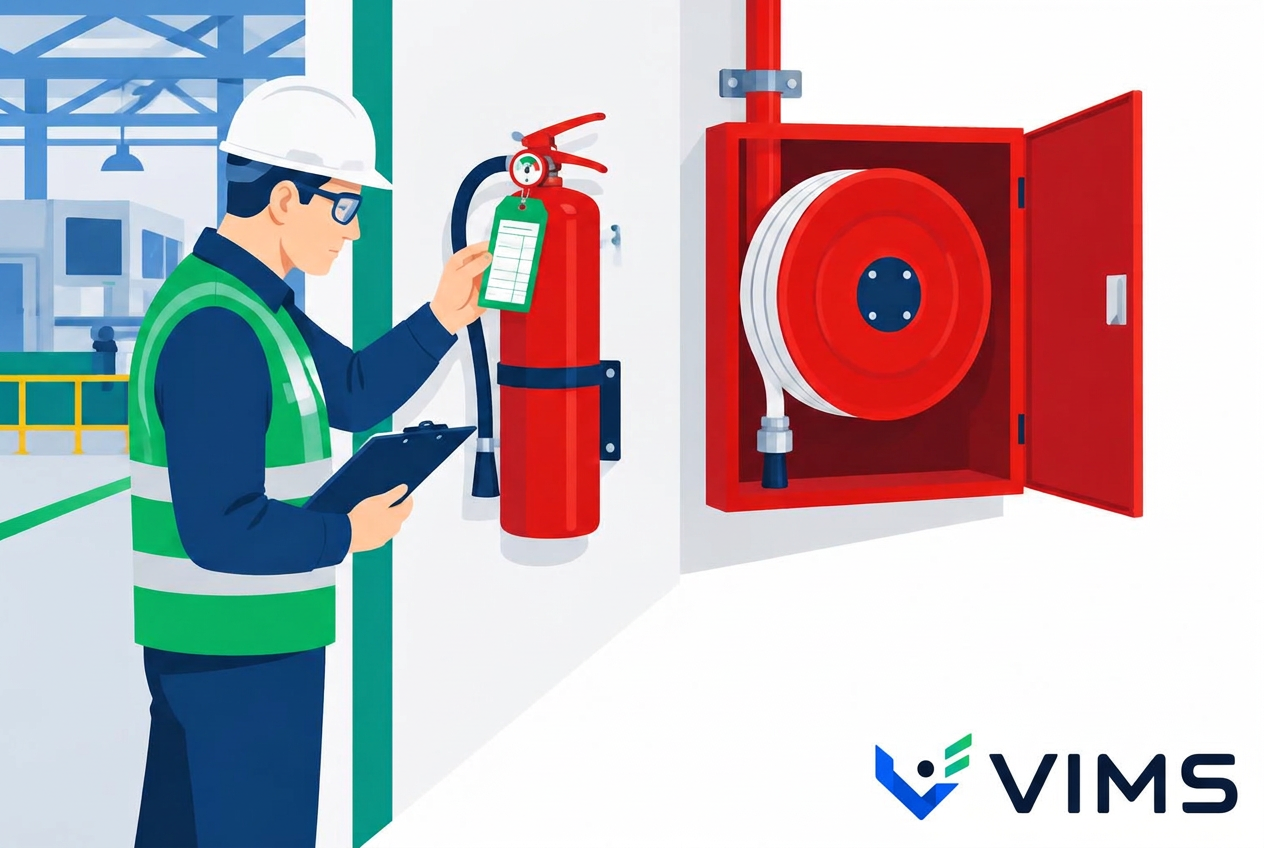
Fire extinguisher and indoor hydrant inspection — helmeted worker checking the inspection tag on a powder extinguisher next to an open hydrant hose reel cabinet — VIMS EHS illustration
Fire extinguisher and indoor hydrant inspection — helmeted worker checking the inspection tag on a powder extinguisher next to an open hydrant hose reel cabinet — VIMS illustration

1. How often to service extinguishers

Short answer: extinguishers undergo periodic servicing — as a rule at least once a year, and more often in harsh environments (humidity, corrosion, dust, extreme temperatures), per the manufacturer's instructions and fire regulations. Servicing may be performed only by an authorised provider — not by a site employee.

On top of that, roughly every 5 years extinguishers undergo an agent replacement or pressure test per the standard and manufacturer, and cylinders have their own test intervals. Practical conclusion: one extinguisher carries several deadlines at once — annual service, agent interval, cylinder test — and each must be tracked separately.

2. The extinguisher nameplate — what to read

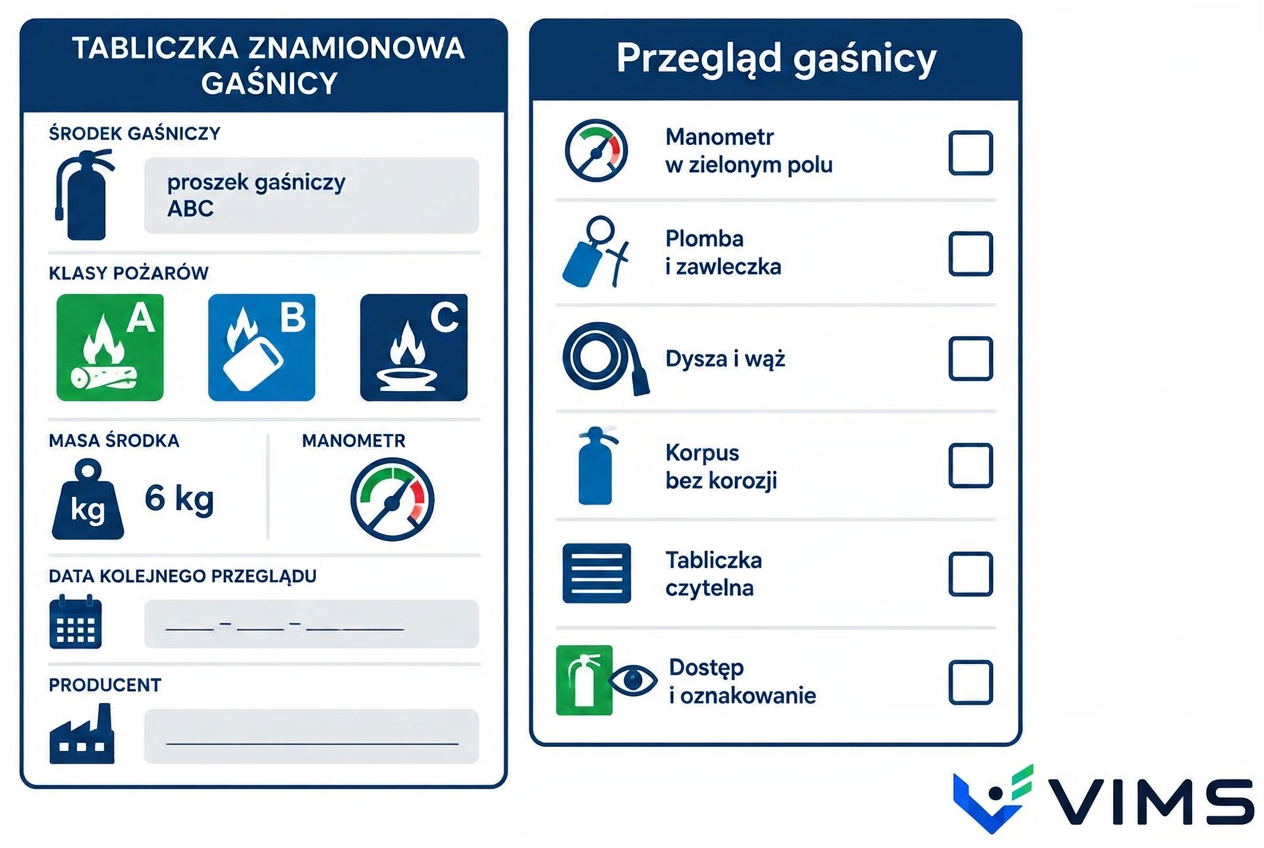
Short answer: the label of an EN 3-compliant extinguisher shows the agent type (powder, CO₂, foam), the fire classes it suits (A, B, C, D, F), agent mass or volume, operating temperature range, manufacturer details and the standard marking. This determines whether the extinguisher fits the hazards of its location — a powder ABC unit at a flammable-liquids station, a CO₂ unit at an electrical switchboard.

During an inspection check label legibility — a damaged or missing plate means nobody knows what is inside or what it is for. In the register record the unit number, type, mass, fire classes, location and dates: last service, next service and agent replacement due.

Fire extinguisher nameplate with fire classes A B C, agent mass and pressure gauge next to a sample inspection checklist: gauge in green zone, seal and pin, nozzle, corrosion-free body, access — VIMS EHS illustration
Extinguisher nameplate elements and a sample interim-check scope (illustrative image).

3. Extinguisher checklist — what to check between services

Short answer: between authorised services the site should run its own simple checks — gauge needle in the green zone (for gauged units), intact seal and pin, working nozzle and hose, corrosion- and dent-free body, legible label, and clear access with proper signage. Such a check fits in a minute per unit.

In practice the most common defects are not missing extinguishers but blocked access (pallets, carts, boxes), a seal removed after someone 'checked if it works', and a unit hung too high or moved without updating the signage. Access and signage checks combine naturally with regular site walkthroughs.

4. Indoor hydrants — scope and intervals

Short answer: indoor hydrants undergo periodic servicing — as a rule an annual inspection covers the cabinet, hose (unrolled and checked), valve, nozzle and signage, and every 5 years hoses undergo a hydraulic test. Periodic checks of system performance and pressure come on top.

As with extinguishers, an authorised provider services the hydrant, but the owner is responsible for access and everyday condition: the cabinet must not be locked without a quick way to open it, blocked, or used as storage. Report any hydrant defect immediately — it is equipment firefighters and staff rely on in a fire.

5. Emergency lighting, the fire power cut-off switch and other fire protection devices — how often are they inspected?

Short answer: the Polish Interior Minister's regulation of 7 June 2010 on fire protection of buildings, other structures and sites classes as fire protection devices not only extinguishing systems and hydrants but also, among others, fire alarm systems, voice alarm systems, smoke control, fire doors and gates with closing devices, emergency escape lighting and the fire power cut-off switch. All of them undergo technical inspections and maintenance according to Polish Standards, technical documentation and the manufacturer's instructions, at intervals the manufacturer sets but at least once a year (§ 3(3) of the regulation).

For emergency and escape lighting the details come from EN 50172: a short functional test on simulated mains failure is usually done monthly, and a full-duration battery test (most often one hour) annually. Results are recorded in a log book. EN 1838 sets photometric requirements, including minimum illuminance on escape routes. Self-testing systems run these tests automatically, but results must still be read and documented.

The fire power cut-off switch disconnects the building supply except circuits of devices that must operate during a fire. The regulation requires it to be located near the main entrance or service connection and marked. The annual inspection covers operation, signage and accessibility and is confirmed by a report. Fire alarm, smoke control and fire door systems are serviced by companies qualified as the system manufacturer requires — the site tracks the schedule and reports.

External hydrants and the fire water supply have additional requirements under the Polish regulation on fire water supply and fire access roads: periodic flow and pressure testing and keeping access routes clear for fire crews. Maintenance of indoor hydrants is detailed in EN 671-3.


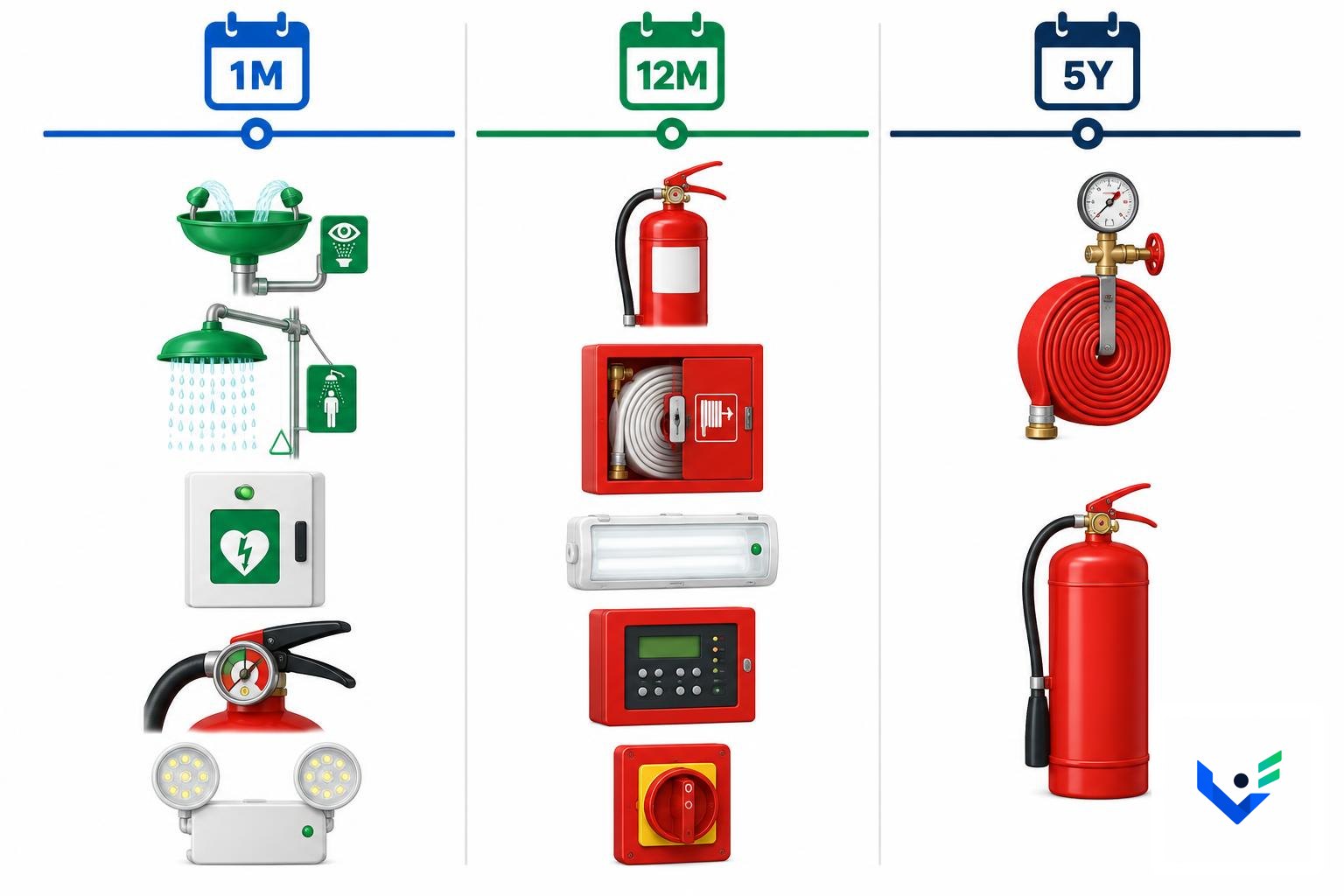
Fire and emergency equipment inspection matrix: monthly eye wash stations, safety showers, AED, extinguisher gauge and emergency lights; every 12 months extinguisher, hydrant, escape luminaire, fire alarm panel and fire power cut-off switch; every 5 years hydrant hose and extinguisher cylinder — VIMS EHS infographic
Typical check intervals: monthly in-house checks, annual authorised servicing and five-year tests (illustrative image; manufacturer instructions apply).

6. How often should an AED, eye wash stations, safety showers and first aid kits be checked?

Short answer: emergency equipment is not a fire protection device, so the annual inspection from the fire regulation does not cover it. The duty comes from art. 209¹ of the Polish Labour Code: the employer provides the means necessary for first aid, firefighting and evacuation and designates employees to give first aid. Check intervals therefore follow manufacturer instructions and the site procedure.

An AED is not mandatory in every Polish workplace, but where one exists it must be ready at any moment. Manufacturers and resuscitation councils recommend regular — in practice at least monthly — checks of the readiness indicator and tracking the expiry of pads (usually 2–3 years) and the battery (usually 4–5 years), with pads replaced after every use. These two dates differ for each unit, so they belong in the register.

Eye wash stations and safety showers are installed where the risk assessment and the safety data sheets of the substances used require them — for example with corrosive chemicals. EN 15154 sets requirements for plumbed showers and eye wash units; manufacturers recommend activating them regularly, usually weekly, to flush stagnant water. Eye wash bottles have a use-by date checked at every inspection.

First aid kits and first aid points are checked under the site procedure — usually monthly — for completeness and expiry dates and restocked after each use. The kit contents are set by the employer together with the occupational physician, and a list of trained first aiders is displayed next to it.

7. Who is responsible for fire safety inspections and what happens if they are missed?

Short answer: under art. 4 of the Polish Fire Protection Act, the owner, manager or user of a building, structure or site must, among other things, equip it with the required fire protection devices and extinguishers and ensure their maintenance and repair so that they operate reliably. An authorised provider performs the work, but responsibility for deadlines stays with the site.

Compliance is checked by the State Fire Service during inspection activities. Findings end in a decision with a deadline for correction, and failure to meet duties may be penalised under art. 82 of the Polish Code of Petty Offences. Missing inspections also matter beyond inspections: an insurer may dispute a claim after a fire, and labour inspectors look at emergency equipment when assessing compliance with art. 209¹ of the Labour Code.

The most common cause of overdue inspections is not lack of knowledge but scattered deadlines: extinguishers have one service provider, emergency lighting another, the fire alarm a third, and AEDs and first aid kits none at all. One shared register of all safety points solves this.

8. How to keep fire and emergency equipment records in VIMS EHS?

In the Registers and inspections module every extinguisher and hydrant has a card with its number, type, location and all deadlines: annual service, agent replacement, cylinder or hose test. The system shows what expires this month — one service visit can be planned instead of several.

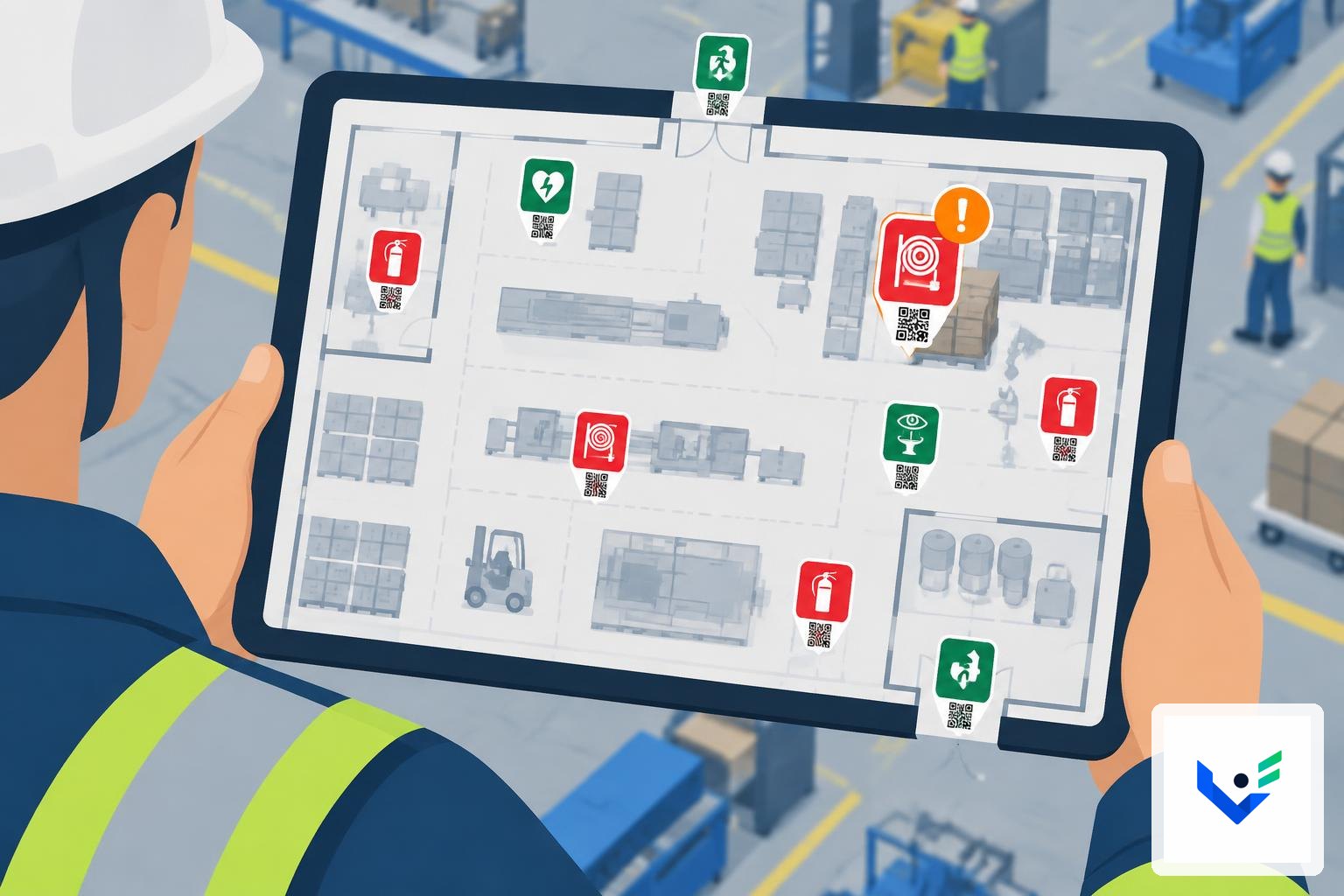
Fire point locations are worth linking to the Maps and zones module, where extinguishers and hydrants appear on the site map next to escape routes — during a round the inspector scans the point on site and ticks the checklist on a phone. A defect can immediately become a report with a removal deadline, and the service record is ready to show at an inspection. VIMS organises the register and deadlines — servicing itself is done by an authorised provider.

The same register holds emergency luminaires, the fire power cut-off switch, fire doors and emergency equipment: AEDs with separate pad and battery dates, eye wash stations, safety showers and first aid kits. The monthly in-house check can be assigned to a designated person as a recurring task in the Inspections and rounds module, and a blocked hydrant or a discharged AED can be reported immediately through hazard reporting.

Production hall plan on a tablet with safety points: extinguishers, indoor hydrants, AED, eye wash station and emergency exits with QR codes and a warning about a blocked hydrant — VIMS EHS illustration
Fire and emergency points on the site plan with QR codes and a defect marker (illustrative image, not an application screen).

9. Glossary: maintenance, hose pressure tests, hydrant flow, pressure-vessel supervision, log book

Maintenance of fire protection equipment and extinguishers follows Polish Standards and the manufacturer's instructions, at intervals set by the manufacturer but at least once a year — as required by the Polish Interior Minister's regulation of 7 June 2010 on fire protection of buildings. In Poland this is often loosely called “extinguisher legalisation”, but formally it is servicing and maintenance.

Type 25 hose reels (semi-rigid hose), type 52 hydrants (layflat hose) and landing valves are checked under the EN 671 series; in practice this means an annual inspection and a hose pressure test at maximum working pressure at least every 5 years. External hydrants (above and below ground) need periodic flow and pressure testing of the fire water supply.

Pressure-vessel supervision (UDT) applies to some vessels — including CO₂ extinguisher cylinders, which require periodic testing; the test date is stamped on the cylinder. The extinguishing agent has its own shelf life, and an expired disposable extinguisher is replaced rather than serviced.

Extinguisher placement follows the Polish regulation: at least one unit of agent (2 kg or 3 dm³) per 100 m² of fire zone area, with a walking distance to an extinguisher of no more than 30 m. The fire equipment sign (ISO 7010) marks its location — keep it on the site safety map and tag inspection points with QR codes or NFC.

The emergency lighting log book records monthly and annual test results, defects and repairs. A duration test checks that a luminaire runs on battery for the required time. The AED readiness indicator is an LED or icon showing the result of the device self-test. A first aid point is a location with a kit or emergency equipment, marked with an ISO 7010 safety sign and a list of designated first aiders.

Fire equipment inspections — intervals at a glance

Typical intervals. Always check current regulations and the manufacturer's instructions.

EquipmentActivityTypical intervalPerformed by
Extinguisherinspection / servicingat least yearly (more often in harsh conditions)authorised provider
Extinguisheragent replacement / testevery 5 years (per standard and manufacturer)authorised provider
Indoor hydrantinspection / servicingat least yearlyauthorised provider
Hydrant hosehydraulic testevery 5 yearsauthorised provider
Emergency lightingfunctional test / duration testmonthly / annually (EN 50172)designated person / service
Fire power cut-off switch, fire alarm, smoke controlinspection and maintenanceat least yearlyauthorised service
AEDreadiness indicator, pads, batterymonthly; dates per manufacturerdesignated site person
Eye wash, safety showeractivation and fluid dateusually weekly (per manufacturer)designated site person
First aid kitcompleteness and expiry datesusually monthly and after usedesignated site person
All fire equipmentaccess and signage checkregularly, e.g. during walkthroughsdesignated site person

Key takeaways

  • Annual extinguisher and hydrant servicing is done by an authorised provider — the site tracks deadlines, access and records.
  • One extinguisher carries several deadlines: service, agent, cylinder — track each separately.
  • The nameplate states the fire classes the unit suits — an illegible label is a defect.
  • The most common nonconformity is not missing equipment but blocked access and a removed seal.
  • Emergency lighting, the fire power cut-off switch and fire alarm systems also need inspection at least once a year.
  • AEDs, eye wash stations and first aid kits have no statutory interval — checks follow the manufacturer and site procedure, with the duty arising from art. 209¹ of the Labour Code.

Frequently asked questions

How often should extinguishers be serviced?

As a rule at least once a year, more often in harsh conditions (humidity, dust, corrosion). Every 5 years the unit undergoes agent replacement or testing. Servicing is done by an authorised provider.

Who can service extinguishers?

Only a provider authorised for fire equipment servicing. A site employee may run own access and condition checks, but not the certification service.

How often are indoor hydrants inspected?

A service inspection at least once a year (cabinet, hose, valve, signage), and a hydraulic hose test every 5 years.

What do the letters A, B, C on an extinguisher mean?

Fire classes the agent suits: A — solids, B — liquids, C — gases (plus D for metals and F for cooking fats). The extinguisher is selected for the hazards of its location.

Can an extinguisher be locked in a cabinet?

Access to firefighting equipment must be free and quick. A cabinet locked with a key nobody has during an event is a nonconformity — break-glass panels or marked enclosures are used instead.

How often are fire hose pressure tests required?

Under the EN 671 series, hoses are tested at maximum working pressure at least every 5 years, in addition to the annual hydrant inspection.

How many extinguishers does a workplace need?

Under Polish rules, at least one unit of agent (2 kg or 3 dm³) per 100 m² of fire zone, with no more than 30 m to the nearest extinguisher. The type is chosen to match the hazards.

Are CO₂ extinguishers subject to pressure-vessel supervision?

CO₂ cylinders require periodic pressure testing under technical supervision; the test date is stamped on the cylinder. The annual service is done by a qualified provider.

How often is emergency lighting tested?

Under EN 50172 a functional test is usually done monthly and a full-duration battery test annually. Results go into the log book.

How often is a fire power cut-off switch inspected?

Like any fire protection device — at intervals set by the manufacturer but at least once a year. The inspection covers operation, signage and accessibility.

How often should a workplace AED be checked?

The readiness indicator is checked regularly, in practice at least monthly, and pad and battery dates are tracked per the manufacturer. Pads are replaced after every use.

Who is responsible for fire equipment inspections?

The owner, manager or user of the building (art. 4 of the Polish Fire Protection Act). An authorised provider does the work, but the site is responsible for deadlines and records.

All fire and emergency deadlines in one register

See how VIMS keeps the register of extinguishers, hydrants, emergency lighting, AEDs and eye wash stations with deadlines, a safety point map and phone checklists.